Tissue Response

Repair

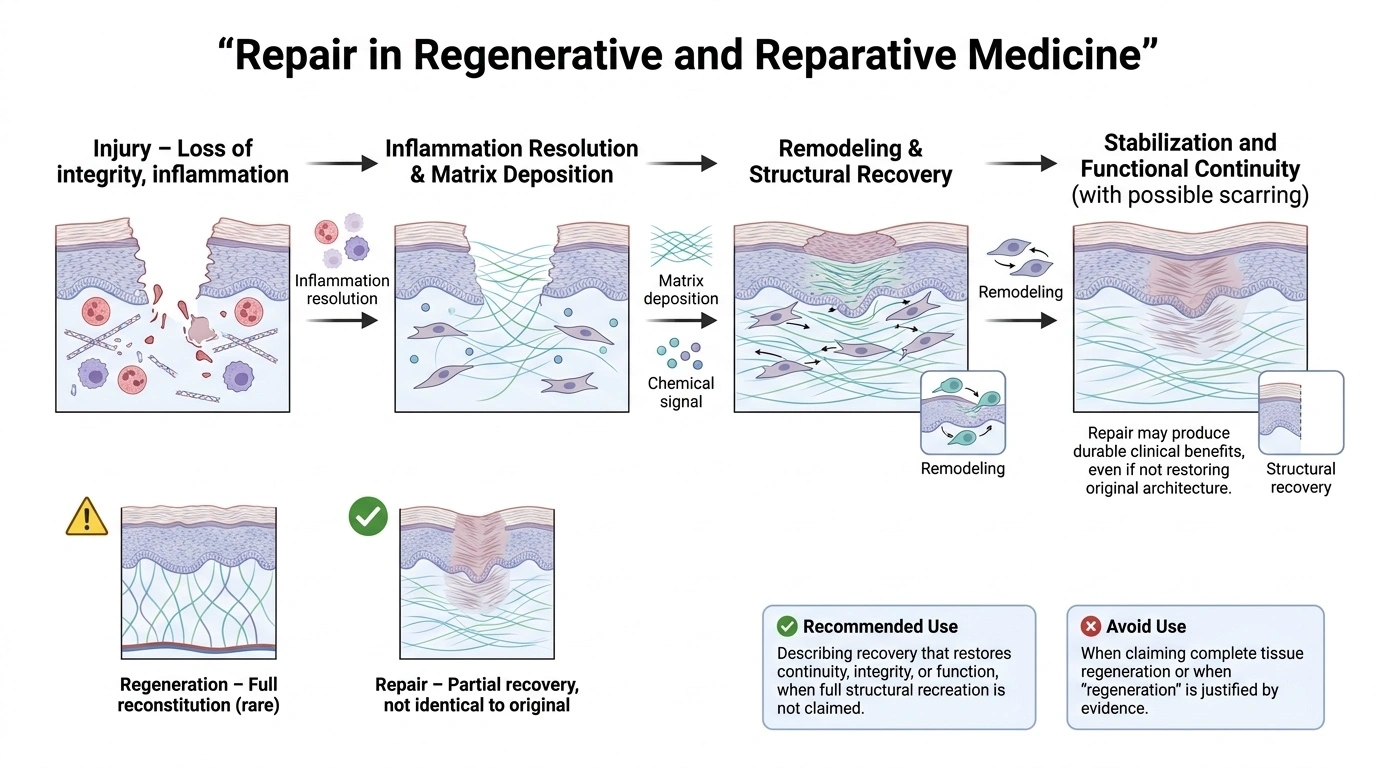
In regenerative and reparative medicine, repair refers to the biologic process by which injured tissue is stabilized and restored to continuity or function, often through a combination of inflammation resolution, matrix deposition, remodeling, and variable degrees of structural recovery.

In regenerative and reparative medicine, repair refers to the biologic process by which injured tissue is stabilized and restored to continuity or function, often through a combination of inflammation resolution, matrix deposition, remodeling, and variable degrees of structural recovery. Repair may produce durable clinical benefit and can include partial restoration of tissue quality, but it does not necessarily imply full reconstitution of original architecture or function. In therapeutic language, repair is often a more accurate and defensible term than regeneration when outcomes are mixed, incomplete, or scar-involved. It is not synonymous with complete tissue regeneration, and it should not be used to imply that the post-treatment tissue is identical to its original state.

Recommended Use:

Use when describing biologic recovery that restores continuity, integrity, or function without claiming full structural re-creation.

Avoid Use:

Avoid when the intended claim is complete tissue reconstitution or when “regeneration” is specifically justified by stronger evidence.

See Also:

Healing, Tissue Regeneration, Tissue Replacement.

Browse More Terms

Rejuvenation

Clinical Observation

Regenerative

Treatment Philosophy

Optimization

Treatment Philosophy

Join Us On The Path Forward.

The field advances in the exchange between practitioners who take the work seriously. Membership is how you stay in that exchange all year — expert education, the growing on-demand library, The ARTS Commons, and the collaborative work of the Tissue Response Compass™, plus member pricing on courses, hands-on training, and gatherings.