Cell Biology

Parenchymal Cells

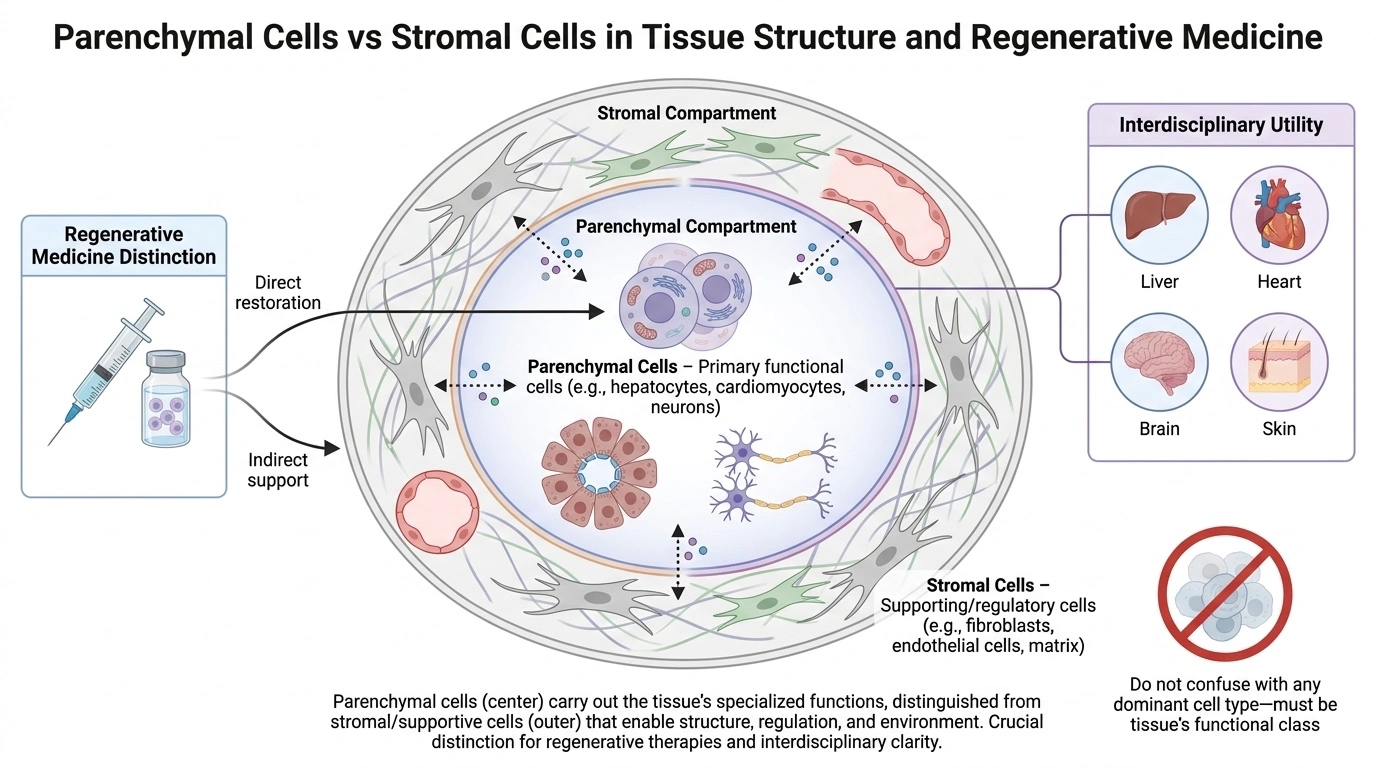
Parenchymal cells are the cells that perform the primary specialized functional work of a tissue or organ, in contrast to stromal or supporting cells that provide structure, regulation, and microenvironment.

Parenchymal cells are the cells that perform the primary specialized functional work of a tissue or organ, in contrast to stromal or supporting cells that provide structure, regulation, and microenvironment. In regenerative medicine, distinguishing parenchymal from stromal compartments helps clarify whether a therapy is intended to restore core tissue function directly, support it indirectly, or influence both. The term is especially useful in interdisciplinary communication because functionally important cells differ across tissues even when supportive mechanisms overlap. It is not a synonym for any dominant cell type in a sample or product unless that cell population is specifically the functional cellular component of the tissue in question.

Recommended Use:

Use when distinguishing function-performing tissue cells from supportive or stromal compartments.

Avoid Use:

Avoid as a vague label for “important cells” when the functional cell class has not been defined in tissue-specific terms.

See Also:

Stromal Cells, Histogenesis, Tissue Regeneration

Browse More Terms

Rejuvenation

Clinical Observation

Regenerative

Treatment Philosophy

Optimization

Treatment Philosophy

Join Us On The Path Forward.

The field advances in the exchange between practitioners who take the work seriously. Membership is how you stay in that exchange all year — expert education, the growing on-demand library, The ARTS Commons, and the collaborative work of the Tissue Response Compass™, plus member pricing on courses, hands-on training, and gatherings.